
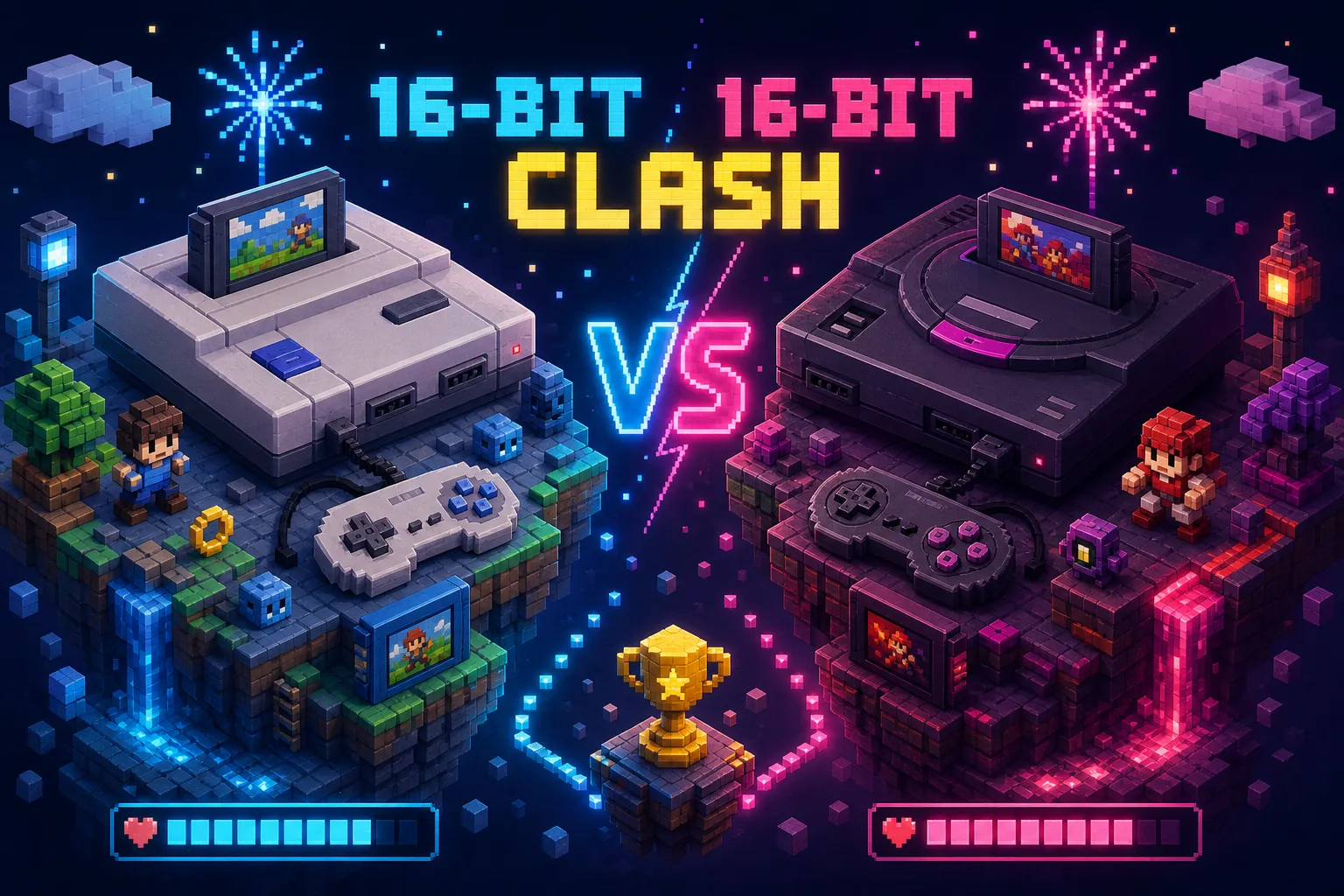
The Sega Genesis vs SNES rivalry was the question on every schoolyard in the early 1990s, and it split friendships down the middle with the clean certainty of a cartridge slot. Were you a Sega kid or a Nintendo kid? Were you rolling with the blue blur on a Genesis, or were you defending Mario’s honor against kids who swore blast processing was a real thing? The 16-bit console war wasn’t just a hardware competition. It was a cultural identity battle, the kind that only happens once in a generation, when two companies genuinely hate each other and the kids buying their products feel it personally.
It’s the kind of comparison we revisit regularly at Gamer das Antigas, not because the answer has changed, but because the argument gets richer every time you dig into it. Here’s the full breakdown: hardware philosophy, killer libraries, censorship wars, add-on chaos, and the regional sales story that most people get wrong. By the end, you’ll know exactly which machine belongs on your shelf and why.
Sega Genesis vs SNES: Two Machines, Two Completely Different Philosophies
On paper, the Genesis looked like the faster machine, and it was. The Motorola 68000 CPU ran at 7.67 MHz compared to the SNES’s Ricoh 5A22 at 3.58 MHz, a gap of more than two to one. But raw clock speed never tells the full story in console hardware, and Sega and Nintendo had fundamentally different ideas about what a 16-bit machine should do.
The SNES compensated for its slower CPU with a more sophisticated Picture Processing Unit capable of displaying 256 simultaneous on-screen colors from a 32,768-color palette. The Genesis could push 64 colors from a palette of 4,096. In practice, Genesis games felt snappy and kinetic, while SNES games looked richer, more painterly, and more cinematic. Neither approach was wrong. They were just different visions of what games could be.
CPU, Sound, and the Sonic Identity of Each Console
Sound design showed the same divide. The Genesis used a Yamaha YM2612 FM synthesizer with six channels plus a Texas Instruments PSG chiptune layer, producing that punchy, metallic sound that defined the era. Streets of Rage 2’s soundtrack is the perfect example: hard, electronic, and unmistakably Sega. The SNES used Sony’s SPC700 with eight ADPCM channels capable of playing back pre-recorded audio samples, giving composers the tools to replicate real instruments. Both systems produced legendary soundtracks. For a technical overview of the Sega Genesis hardware and design choices, there are good references that break the platform down in detail.
Graphics, Mode 7, and the Enhancement Chip Advantage
Then there was Mode 7. The SNES’s ability to rotate and scale background layers created pseudo-3D effects that powered F-Zero’s racing tracks and Super Mario Kart’s road perspectives. Star Fox’s polygonal 3D was a different story entirely: that was driven by the Super FX enhancement chip embedded directly in the Star Fox cartridge, not Mode 7. Sega countered the SNES graphics advantage with “blast processing,” a marketing term that referred loosely to DMA access speeds and carried more slogan weight than technical precision. It worked anyway: millions of American kids were convinced the Genesis was technically superior because of a phrase nobody could fully define. If you want a deeper SNES technical deep dive that explains Mode 7 and enhancement chips, the SNES technical resources are worth a read: SNES technical deep dive.
Sega Genesis vs SNES: The Exclusive Libraries That Sealed Each Console’s Legacy
Hardware specs are the scaffolding. The games are the building. The SNES library reads like a hall of fame where almost every inductee is actually deserving. Super Metroid sits at the top of nearly every retrospective ranking and still functions as a masterclass in environmental storytelling. Chrono Trigger, A Link to the Past, and Final Fantasy VI anchor the SNES exclusives list on the RPG side, while Super Mario World, Donkey Kong Country, and EarthBound demonstrate how broad the design ambition ran across genres. No other 16-bit machine came close to matching that library for depth, and the SNES’s JRPG output alone justifies the console’s existence. If you want more context on the SNES’s regional history and legacy, see the complete history of the SNES in Brazil on Gamer das Antigas: complete history of the SNES in Brazil.
The Genesis library fought back with a completely different identity: kinetic, arcade-faithful, and willing to go places Nintendo wouldn’t. Sonic 2 defined speed-based platforming in a way that still influences designers today. Streets of Rage 2 remains one of the finest brawlers ever made. Gunstar Heroes pushed the hardware to limits that genuinely surprised developers who thought they knew what the Genesis could do. Phantasy Star IV gave the console a JRPG answer worthy of the competition. The Genesis also won the fighting game war early in the generation, before Nintendo recovered with superior ports. If you want to go deep on the Genesis library, the Gamer das Antigas collector guide has title-by-title breakdowns and rarity rankings ready for you.
Mortal Kombat and the Console Identity Divide
September 1993 is when the console war became something else entirely. When Mortal Kombat launched simultaneously on both systems, Nintendo of America required all blood to be replaced with gray sweat and stripped out the fatalities. Sega allowed a blood code, ABACABB, that restored the full arcade experience. The Genesis version shipped with an MA-13 rating; the SNES version shipped without a rating at all. The Genesis outsold the SNES version by three to four times. That gap wasn’t just a sales number. It was a statement about who each console was for.
The Genesis became the mature console overnight. The SNES became the kid-friendly alternative, a label that stuck even as Nintendo scrambled to correct it. Lethal Enforcers, Art of Fighting, and Night Trap all reinforced the same pattern: Genesis permissiveness versus SNES conservatism. By the time Mortal Kombat II arrived in 1994, Nintendo reversed course with an uncensored port, but the reputational damage among older teen audiences had already been done. One more consequence nobody planned for: the congressional hearings triggered by the Mortal Kombat controversy directly led to the creation of the ESRB rating system in 1994, which reshaped the entire industry.
Add-ons, Enhancement Chips, and the Hardware Arms Race
Sega released the Sega CD in 1992 for $299, adding CD-ROM storage, full-motion video capability, and superior audio to the Genesis. The peripheral sold 2.24 million units worldwide, a number that sounds reasonable until you consider that fewer than 60,000 units moved in the UK at launch. The library had genuine highlights: Sonic CD, Lunar: The Silver Star, and Snatcher stand out. But FMV shovelware and thin first-party support undermined the peripheral’s reputation before it could build one. Then came the 32X in 1994, a cartridge-slot add-on promising 32-bit processing for early 3D titles. The problem was math: developers now faced three possible hardware targets (Genesis alone, Genesis with Sega CD, Genesis with 32X), and most chose to skip the add-ons entirely. That fragmentation accelerated the transition to the Saturn and left both peripherals with libraries too thin to justify the investment. For more on that peripheral’s design and history, see the Sega CD entry: Sega CD.
The SNES took a smarter approach by embedding enhancement chips directly inside cartridges. The Super FX chip powered Star Fox’s 3D polygon engine, while Mode 7 handled the scaling effects seen in F-Zero and Super Mario Kart. The SA-1 chip, used in Kirby Super Star and Super Mario RPG, boosted CPU performance without requiring consumers to buy any additional hardware. The install base stayed unified, developers had clear targets, and the results were commercially and critically successful. No fragmentation, no confused consumers, no $299 add-on collecting dust.
How the Sales War Actually Played Out
The conventional wisdom is that Nintendo won the 16-bit era. The global numbers support it: SNES finished at 49.1 million units versus the Genesis’s 35.25 million. But the regional picture is far more complicated, and that nuance is worth understanding before you settle on a narrative.
In North America, Sega genuinely won for several years running. By January 1992, the Genesis held 65% of the 16-bit console market, the first time Nintendo had lost market leadership since 1985. Sega claimed 55% of all 16-bit hardware sales in 1994. A 2014 Wedbush Securities analysis of revised NPD data estimated that the SNES ultimately outsold the Genesis in the US by about 2 million units over the full product lifecycle, but for several of the most commercially important years, the Genesis owned North American retail. Europe told an even stronger Sega story: by November 1994, 63% of 16-bit consoles sold in Western Europe were Sega systems, with a 9.17 million to 5.05 million install base advantage across the region. If you’re interested in regional variations and how consoles fared in specific markets beyond the usual US/JP split, the Mega Drive history in Brazil is a revealing example of how different countries wrote unique chapters in the 16-bit story: Mega Drive history in Brazil.
Japan is where Nintendo rebuilt its global lead. The Mega Drive was essentially invisible in its home market, finishing with fewer than one million units sold against the Super Famicom’s roughly 20 million. That single market handed Nintendo the worldwide championship. Without Japan in the equation, this rivalry’s outcome is genuinely unclear. Depending on how you draw the lines, Sega was either the company that briefly toppled Nintendo or the one that won everywhere it actually competed and lost only at home. Both readings are defensible.
Sega Genesis vs SNES: Which Console Belongs in Your Collection Today?
The SNES makes the most compelling case if your priorities are long-form experiences and genre depth. The RPG library alone, anchored by Chrono Trigger, Super Metroid, and A Link to the Past, justifies the investment for anyone who wants games they can lose themselves in for dozens of hours. The SNES controller also holds up well for extended modern sessions; most players who return to both systems find it the more comfortable option for marathon play. The trade-off is cost: SNES cartridges, especially RPGs and boxed complete copies, have become genuinely expensive in the collector market, with many titles regularly fetching two to three times their Genesis counterparts on resale platforms. Plan your budget accordingly.
The Genesis makes more sense as your first retro purchase if you want arcade authenticity and a lower barrier to entry. Streets of Rage 2 and Gunstar Heroes alone justify the investment, and the Sonic trilogy adds replay value that holds up decades later. Cartridge prices generally sit below SNES equivalents, a trend consistently reflected across major collector marketplaces, making the Genesis the more accessible door into 16-bit collecting. The library leans hard into action and competition, rewarding players who want games that feel immediately responsive rather than slowly revelatory. And if you’re still curious about that blood code after all these years, that curiosity probably tells you something about which side of the 90s you were actually on.
The War Never Ended, It Just Changed Generations
The Sega Genesis vs SNES debate has no clean winner, and that’s precisely why it still resonates three decades later. Each console dominated in the areas that reflected its core philosophy: the Genesis built its reputation on speed, arcade authenticity, and cultural edge, while the SNES earned its legacy through color depth, an unmatched software library, and Nintendo’s enormous presence in Japan. Many titles from both libraries are still considered genre benchmarks by players and critics who grew up with them. The honest collector’s answer in 2026 is the same one it’s always been: both machines deserve a spot on your shelf.
For readers who want to go deeper, Gamer das Antigas has the content ready: hardware RGB mod guides, breakdowns of the rarest Genesis cartridges worth hunting, and retrospectives on how Super Metroid changed game design permanently, along with analysis of how these two machines shaped every console that followed them. If you’d like a broad comparison of the era’s standout systems, see our best consoles of the 90s roundup. The 16-bit era didn’t just define a generation of gamers. It set the template for how the entire industry thinks about competition, identity, and what it means to pick a side. That’s worth understanding completely.
Deixe um comentário