
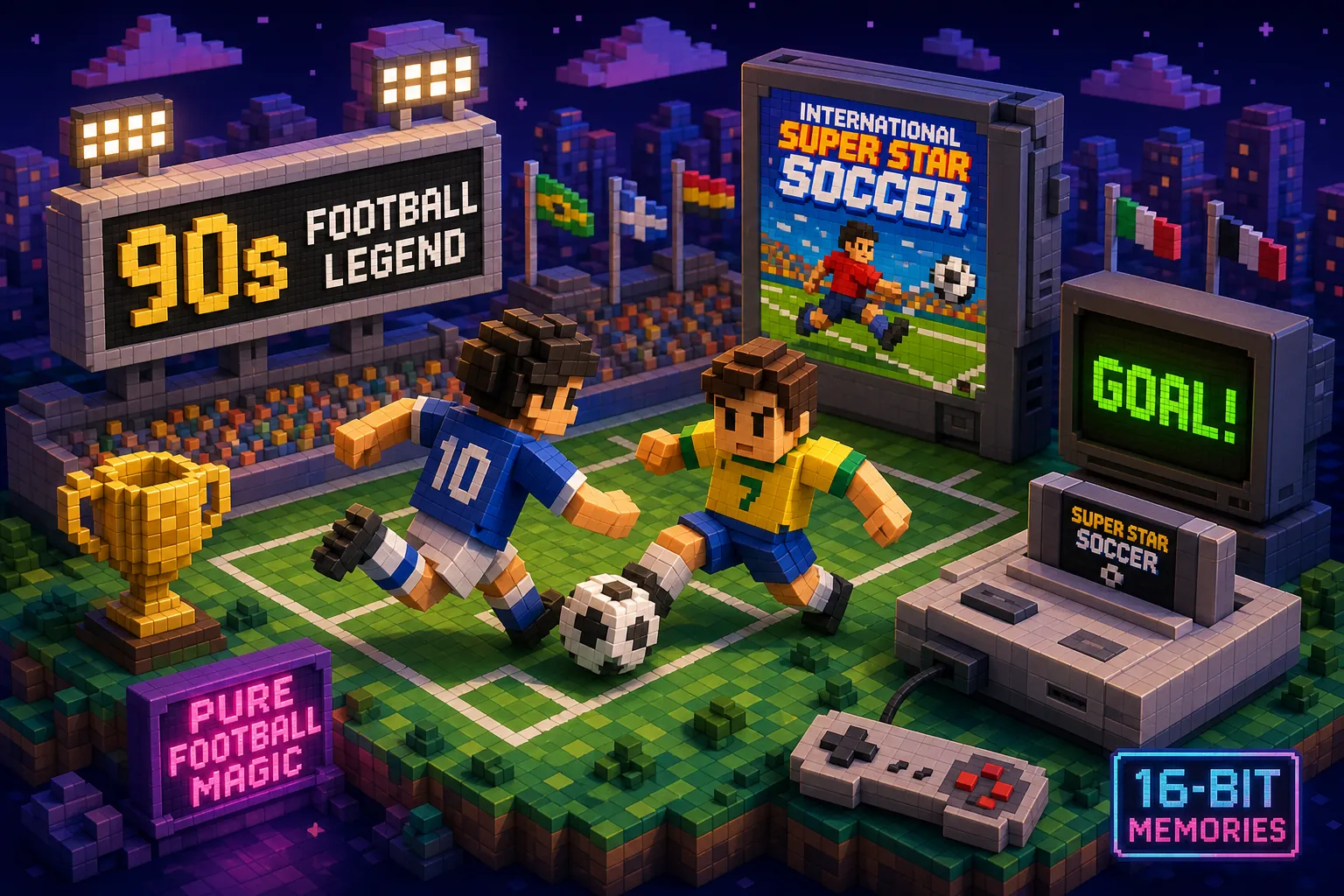
Picture two kids in 1996, crouched in front of a television, one locked onto Brazil, the other commanding Germany. The referee sound effect cuts through the living room. Neither player blinks. That was International Super Star Soccer, and if you were serious about football on a console, that was your game.
Konami built something in the mid-90s that FIFA couldn’t touch for years. The ISS franchise ran from 1994 through the early 2000s, spanning the Super Nintendo, Sega Genesis, Nintendo 64, and PlayStation 1, and it earned its reputation entirely through gameplay. No marketing budget, no celebrity endorsements, just football that felt right from the first kick. This is the story of why that series still matters to anyone who cares about retro sports gaming.
How Konami launched a football franchise nobody saw coming
In 1994, EA’s FIFA International Soccer arrived with its isometric camera and impressive presentation for the time. It looked like the future of football gaming. Then Konami quietly released the original International Super Star Soccer on the Super Famicom, known in Japan as Jikkyō World Soccer, a side-view football game that immediately felt more responsive, more alive, and more honest about what playing football actually feels like in a controller’s hands.
Konami’s design philosophy from the start was clear: arcade accessibility combined with enough depth to reward players who put in the hours. The original title already introduced innovations FIFA hadn’t considered, including compliance with the real-world back-pass goalkeeper rule introduced in 1992. That detail alone signaled that Konami was paying close attention to football, not just to market trends.
The 1994 original: what it got right from the start
The first International Super Star Soccer on Super Famicom featured large, detailed sprites that were ahead of anything else in the football genre on 16-bit hardware. The controls responded without lag, a detail that sounds minor until you’ve played FIFA’s floaty alternative. Konami also included a Scenario Mode, a feature that challenged players with specific match situations rather than just dropping them into a generic tournament. That kind of ambition in a 1994 sports title was genuinely unusual.
Why the football world paid attention
Word spread fast in Europe and Japan. Players who imported the Super Famicom version talked about it in gaming magazines and schoolyard conversations with the kind of enthusiasm usually reserved for RPGs and action titles. By the time ISS Deluxe was ready to ship in late 1995, Konami already had a reputation to protect and a fanbase ready to upgrade.
ISS Deluxe, How International Super Star Soccer made 16-bit football feel complete
ISS Deluxe, released in late 1995 on SNES and Sega Genesis, is the version most players remember as definitive for the 16-bit era. It introduced eight individual player stats: speed, dash, shot power, intelligence, balance, jump, stamina, and dribble. Each number on that list mattered in actual gameplay. You could feel the difference between a slow defender and a quick winger, between a striker with high shot power and one who relied on placement.
The game also brought substitution management with fatigue tracking, formation editing, and an expanded Scenario Mode that gave players specific challenges to solve. The gameplay loop was tight and deliberate. ISS Deluxe didn’t try to simulate every second of a real football match; it distilled the feeling of football into something that ran at a clean 60 frames per second on hardware that was nearly a decade old by that point.
What made its mechanics stand out from everything else
The core control system rewarded skill over luck. Holding the run button, timing tackles correctly, and executing bicycle kicks through the juggle mechanic all required practice. You couldn’t mash your way to victory against a good opponent. The game’s depth revealed itself gradually, which is exactly the kind of design that keeps players coming back weeks after the initial novelty wears off.
Headers, volleys, and curling shots all had their own timing windows, and each one demanded a different read of the play. A curling shot required you to time the button press just after the striker planted his standing foot, while a bicycle kick asked you to juggle twice before committing to the overhead swing. A well-timed bicycle kick felt genuinely earned because it was. That sense of reward is something modern football games have chased for thirty years without always catching.
The Mega Drive version and what it meant for Brazilian players
The Genesis port of ISS Deluxe carried specific significance for Brazilian players. Thanks to TecToy’s distribution network, the Mega Drive held roughly 80% of the Brazilian console market through much of the 90s, which meant the Genesis version of ISS Deluxe was the one Brazilian players actually had access to. That version also supported up to 8 players simultaneously (4 vs. 4), making it a natural centerpiece for the hourly-play gaming venues that defined how many Brazilian kids experienced consoles during that era.
The broader context of TecToy’s role in Brazilian gaming culture, and how the Mega Drive became the dominant console in the country while the SNES ruled in Japan and the United States, is something Gamer das Antigas covers in depth. If you want to understand why Brazilian players experienced the ISS franchise differently from European or Japanese audiences, that SNES vs. Mega Drive history is where the full story lives.
How International Super Star Soccer put FIFA on the back foot
The jump to 3D is where the ISS franchise separated itself completely from the competition. ISS 64 arrived on Nintendo 64 in 1996 and 1997, expanding the roster to over 30 national teams and introducing faster dribbling mechanics, one-two passing combinations, and goalkeeper AI that reacted intelligently to crosses and through-balls. Period reviews described the game as having no lag time like FIFA 64 and called it the standout gameplay experience on the platform. That wasn’t hyperbole. FIFA 64 released around the same time with a button response delay that reviewers described in harsh terms. ISS 64 made FIFA 64 look unfinished.
ISS 64: what the jump to 3D actually delivered
The improvements in ISS 64 went beyond just adding a third dimension. Player collision physics felt weighted and believable. Tackling options were more varied, with standing challenges and slide tackles behaving differently depending on timing and approach angle. Volley mechanics and expanded tournament modes gave the game genuine replay value beyond quick pickup matches. FIFA 64’s interface looked dated by comparison within weeks of both games hitting shelves.
Contemporary player reviews from that era called FIFA 64 “an early contender for the N64’s worst game ever” in direct contrast to ISS 64. That wasn’t a close competition. It was the beginning of a multi-year stretch where Konami simply outclassed EA in console football, a run that would eventually carry through to Pro Evolution Soccer’s peak years.
ISS Pro and the bridge to Winning Eleven
ISS Pro, released on PlayStation 1 in 1997 and known as Goal Storm ’97 in North America and Winning Eleven ’97 in Japan, pushed realism further than any football game had managed on home hardware at that point. It brought over 50 national teams, comprehensive player editing tools, and tactical depth that went well beyond what ISS Deluxe had offered two years earlier, pointing directly at what Winning Eleven and eventually Pro Evolution Soccer would become.
Konami’s strategy at this stage was to consolidate its two football franchises, the arcade-leaning International Super Star Soccer and the simulation-focused Winning Eleven, into a single unified product line. The arcade DNA of ISS provided the global brand identity, while the Winning Eleven simulation philosophy provided the mechanical depth. The merger produced a product that dominated console football gaming for the better part of a decade.
The ISS legacy: from Konami’s golden era to Pro Evolution Soccer
International Super Star Soccer didn’t just produce good football games. It established a design philosophy built on a core belief: player skill should determine outcomes, not licensing budgets. Konami’s rosters used fictional names and altered spellings throughout most of the ISS run because of FIFA licensing limitations. Players in Brazil knew “Allejo” as a thinly veiled version of Bebeto, and that fictional player became a genuine cultural icon in Brazilian gaming circles precisely because the gameplay was good enough to make you forget you were playing a legal workaround.
The franchise also proved that a Japanese studio could dominate a genre historically tied to European market tastes. By the late 1990s, ISS titles were outscoring FIFA equivalents in head-to-head magazine reviews across the UK, Germany, and Brazil, a remarkable achievement for a series that began as a Super Famicom import. Konami read football correctly, built mechanics that rewarded skill, and shipped consistently across multiple platforms at a time when cross-platform quality control was genuinely difficult to maintain.
Why the arcade DNA survived all the way to PES
The direct line from ISS Deluxe’s responsive controls to the Winning Eleven series’ legendary touch system is not difficult to trace. The same philosophy runs through all of it: the ball should feel connected to the player, and the player should feel connected to the controller. PES earned its reputation through the 2000s as the game serious football players preferred for exactly this reason. That reputation started with a 1994 Super Famicom release that most people outside Japan never saw coming.
What ISS’s rise tells us about the 90s console wars
Konami’s cross-platform strategy, releasing ISS titles across SNES, Genesis, N64, and PS1, meant the franchise could reach players regardless of which console they owned. In Brazil, where the Mega Drive dominated but Super Nintendo cafes and hourly-play venues also existed, this breadth of availability mattered enormously. The ISS story is inseparable from the broader SNES vs. Mega Drive rivalry, and understanding one helps you understand the other.
How to play International Super Star Soccer today
For anyone who wants to go back, or experience International Super Star Soccer for the first time, the options fall into two clear categories: physical hardware and emulation. Physical copies of ISS Deluxe for SNES range from roughly $79 for a loose cartridge to $800 for a complete boxed copy, with sealed copies selling as high as $1,600 when they surface. Those prices have climbed steadily over the past several years.
There are no official digital re-releases of any ISS title on modern platforms as of 2026. Nintendo Switch Online does not include any ISS games in its library, and Konami has not published the series through any virtual console or subscription service. Emulation is the most realistic route for most players who want to experience the franchise without paying collector prices.
Physical copies: what to expect on the current market
ISS Deluxe Complete in Box (CIB) with both box and manual currently runs between $250 and $800 depending on condition. Loose cartridges start around $79. ISS 64 and ISS Pro physical copies are more accessible price-wise and worth checking on dedicated retro marketplaces, though CIB pricing for those titles fluctuates more than ISS Deluxe. Condition matters significantly to final price on all three, and the collector market for 90s sports titles has shown no sign of cooling.
Where to play ISS today: emulation options
RetroArch with SNES and N64 cores covers ISS Deluxe and ISS 64 cleanly on modern hardware. PCSX2 handles ISS Pro on the PS1 side. Choosing a starting point depends on what you’re after: ISS Deluxe gives you the classic 2D experience that defined the franchise’s early identity, ISS 64 delivers the 3D leap and the gameplay that buried FIFA 64, and ISS Pro offers the deepest feature set of the three. They’re different versions of the same core promise, and all three are worth your time.
The cartridge is old, but the story keeps running
International Super Star Soccer earned its place in gaming history through gameplay that delivered on the promise of football without shortcuts. In Brazil, where the Mega Drive was the dominant console and football runs through the national identity the way a street game bleeds into an empty Saturday afternoon, ISS hit with a force that very few games could match across any genre. The series spoke directly to what Brazilian players wanted from a football game and gave them something that felt genuinely theirs, even under fictional player names and borrowed licensing arrangements.
The franchise’s influence never fully disappeared. It lives in every PES review that praises “the touch,” in every retro gaming conversation about what made 90s console football feel different from what came before. The arc from International Super Star Soccer’s Super Famicom debut to PES’s global dominance in the 2000s is one of the more compelling stories in sports gaming history. It starts with a side-view football game that nobody outside Japan expected to matter, and ends with a legacy that’s still being talked about three decades later.
At Gamer das Antigas, this kind of history is exactly what we’re here to document. The TecToy story, the SNES vs. Mega Drive rivalry, the games that defined a Brazilian generation, all of it connects. If International Super Star Soccer brought you here, there’s a lot more of the same waiting for you in the archive.
Deixe um comentário